Sign In




 Facebook
 X-Twitter
 Instagram
 Linkedin
 Youtube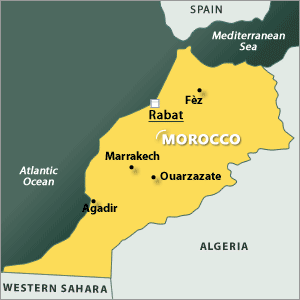

Significance
Immigration from Morocco has generally reflected French and Spanish colonial rule, economic opportunity, educational advancement, professional employment, family reunification, political change, international business, and skilled migration.
Migration from Morocco has historically been shaped by its strategic location between Africa and Europe and its longstanding commercial and cultural connections with the Mediterranean region. Moroccans have commonly migrated to France, Spain, Belgium, the Netherlands, and other European countries for employment, education, and family reunification. Overseas migration to the United States has gradually expanded through higher education, professional employment, entrepreneurship, scientific research, and business investment. Political stability, economic modernization, and international educational exchange have further contributed to migration in recent decades. Today, Moroccan immigrants in the United States include students, physicians, engineers, entrepreneurs, academics, and skilled professionals who maintain strong cultural, linguistic, religious, and family ties with their homeland.
Moroccan Migration Before Independence
Before independence, Morocco was an independent sultanate that became divided into French and Spanish protectorates in 1912, while the city of Tangier was administered as an international zone for part of the colonial period. Migration during this era was influenced by agriculture, trade, fishing, mining, government administration, military service, religious scholarship, and regional commerce. Residents frequently travelled throughout North Africa, Europe, and the Middle East as merchants, farmers, craftsmen, students, teachers, civil servants, and members of extended families. Direct migration to the United States remained relatively limited because political, educational, and commercial connections were centred primarily on France, Spain, and neighboring Mediterranean countries. Morocco regained its independence on March 2, 1956, and the United States, which has maintained diplomatic relations with Morocco since 1787, continued its longstanding partnership with the newly independent nation.
Late-Twentieth- and Early-Twenty-First-Century Immigration
Migration increased after independence as expanding educational opportunities, economic development, globalization, and professional careers encouraged many Moroccans to seek opportunities abroad. Students, physicians, engineers, scientists, academics, entrepreneurs, information technology specialists, business professionals, and researchers increasingly travelled to the United States for university education, specialized employment, scientific research, investment, or family reunification. Family sponsorship, multinational corporations, and academic exchange programs have continued to strengthen migration in recent decades. In the United States, Moroccan immigrants often rely on family networks, mosques, cultural associations, alumni organizations, and professional groups for support with housing, employment, education, and community integration while preserving Arabic, Amazigh (Berber) languages, French, traditional cuisine, music, religious practices, cultural heritage, and close relationships with relatives in Morocco.