Sign In




 Facebook
 X-Twitter
 Instagram
 Linkedin
 Youtube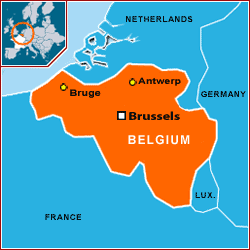

Significance
Belgian immigration to the United States has generally reflected agricultural hardship, industrial change, limited employment, religious connections, the two World Wars, professional opportunities, education, and family reunification.
Belgian migration to the United States remained relatively limited compared with migration from several other European countries. Noticeable settlement began during the nineteenth century and increased between the 1870s and the beginning of the twentieth century, when farmers, craftspeople, industrial workers, and families searched for land and employment. Many settled in Wisconsin, Michigan, Illinois, and other parts of the Great Lakes and Midwest. Flemish immigrants often worked in manufacturing and skilled trades, while many Walloon families established agricultural communities. Migration declined after American immigration restrictions were introduced and Belgium’s economy became more stable. After World War II, Belgian arrivals increasingly included scientists, academics, executives, technicians, and other highly skilled professionals.
Belgian Migration Before Independence
Belgian migration to North America was uncommon before Belgium became an independent country in 1830. People from the territories that later formed Belgium occasionally arrived as merchants, missionaries, soldiers, sailors, artisans, and members of Dutch or French colonial enterprises. Because Belgium did not yet exist as a sovereign state, these settlers were usually identified as Dutch, French, Flemish, Walloon, or subjects of the European power governing their homeland. Political and economic changes eventually led Belgium to declare independence from the Netherlands in October 1830. The United States formally recognised Belgian independence in 1832 and established diplomatic relations during the same year. These connections later supported greater commercial exchange and made organised migration between Belgium and the United States easier.
Nineteenth- and Twentieth-Century Immigration
Belgian immigration increased during the second half of the nineteenth century as population growth, agricultural difficulties, industrialisation, and the search for better wages encouraged people to leave. Between 1871 and 1930, approximately 137,000 Belgian emigrants travelled to the United States, many departing through Antwerp and settling in Michigan, Wisconsin, Illinois, and other Midwestern areas. Belgian communities developed farms, churches, businesses, mutual-aid societies, newspapers, and cultural organisations. Immigration slowed during World War I, the restrictive quota period, the Great Depression, and World War II. After 1945, migration increasingly involved highly skilled workers, researchers, business professionals, students, and people joining relatives. Belgian Americans continued to preserve Flemish and Walloon traditions while contributing to agriculture, manufacturing, construction, science, education, commerce, music, and community life.