Sign In




 Facebook
 X-Twitter
 Instagram
 Linkedin
 Youtube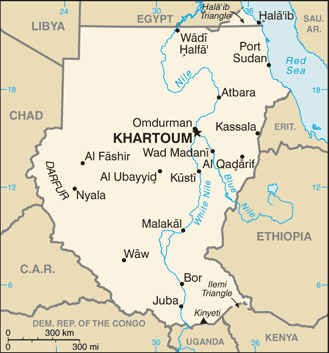

Significance
Sudanese immigration has generally reflected colonial rule, civil wars, political repression, ethnic and religious conflict, economic hardship, refugee displacement, education, professional employment, asylum, and family reunification.
Sudanese migration to the United States remained limited until the late twentieth century. Early arrivals mainly included students, diplomats, academics, religious workers, merchants, and professionals seeking education or specialised employment. Immigration increased from the 1990s as civil war, political instability, persecution, and violence in Darfur forced many Sudanese to seek safety abroad. Refugees, asylum seekers, doctors, engineers, educators, businesspeople, and relatives joining established families settled in cities across the United States. Sudanese communities formed churches, mosques, cultural associations, restaurants, businesses, and support networks while preserving Arabic, Indigenous languages, religious traditions, food, music, and close family connections.
Sudanese Migration Before Independence
Before independence, Sudan was governed jointly by Britain and Egypt under the Anglo-Egyptian administration. Migration was shaped by regional trade, pastoral movement, agriculture, military service, pilgrimage, colonial employment, and education. Sudanese traders, workers, students, soldiers, and religious scholars travelled mainly to Egypt, Ethiopia, Chad, Eritrea, Uganda, and other neighbouring territories. Some studied or worked in Britain and other parts of the British Empire, but direct settlement in the United States remained uncommon. Colonial development created new towns, railways, schools, and administrative employment, while regional inequalities contributed to political tensions between northern and southern Sudan. Sudan became independent on January 1, 1956, and the United States recognised the new republic that same day.
Late-Twentieth- and Early-Twenty-First-Century Immigration
After independence, recurring civil wars, military governments, economic decline, famine, and political persecution displaced large numbers of Sudanese. Migration increased during the second civil war, which lasted from 1983 until the 2005 Comprehensive Peace Agreement, and during the Darfur conflict that began in 2003. Sudanese migrants reached the United States through refugee resettlement, asylum, university programmes, skilled employment, family sponsorship, and the Diversity Visa programme. South Sudan separated from Sudan in 2011, creating two independent countries and distinct migrant identities. Armed conflict between the Sudanese Armed Forces and the Rapid Support Forces began in April 2023, producing another major displacement crisis and forcing millions to flee their homes within Sudan or seek safety in neighbouring countries.