Sign In




 Facebook
 X-Twitter
 Instagram
 Linkedin
 Youtube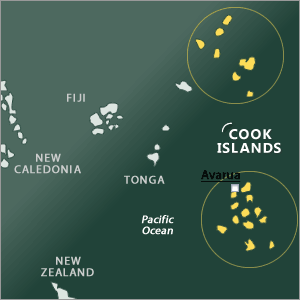
More Information
More Information
Street Soccer in Cook Islands
Street soccer is a popular recreational activity in the Cook Islands, where children and teenagers enjoy informal football matches in village areas, school grounds, parks, beaches, and community open spaces. These friendly games bring young people together and provide an enjoyable way to stay active while developing their football skills.
Playing in smaller spaces helps participants improve close ball control, accurate passing, quick movement, and teamwork. The relaxed nature of street soccer encourages creativity, confidence, and decision-making, allowing players to learn and improve through regular games with friends.
Street soccer offers an accessible and affordable way for communities across the Cook Islands to enjoy football without requiring professional facilities. It promotes healthy lifestyles, strengthens friendships, and encourages young players to continue their involvement in the sport.
Street Soccer Culture in Cook Islands
Football continues to grow in the Cook Islands, and street soccer is often where many young players first develop their interest in the game. Informal matches organised by schools, families, and local communities create a friendly environment where players of different ages and abilities can participate.
Skills Developed Through Street Soccer
Street soccer helps players improve dribbling, first touch, passing accuracy, agility, balance, ball control, and awareness. Regular play also strengthens communication, confidence, and quick decision-making during matches.
Street Soccer and Community Development
Street soccer brings communities together through football while encouraging active lifestyles and positive social connections among young people. It also provides aspiring players with valuable experience before progressing to school teams, local clubs, or organised football programmes.
The Cook I. in the DMV Metro

- Official Bilateral Representation: The core point of contact is the Embassy of the Cook Islands in Washington, D.C.. Officially recognized by the United States as a sovereign state in 2022, the diplomatic mission serves as the primary formal link for cultural exchange, tourism promotion, and emergency services for nationals living across the East Coast.
- Civic Advocacy: Local representation is generally managed under the umbrella of broader district agencies. The D.C. Mayor's Office on Asian and Pacific Island Affairs (MOAPIA) provides funding, coordinates public programs, and advises local government on the welfare and social resource accessibility of the region's diverse Pacific Islander communities.
- Cultural & LGBTQ+ Alliances: Local organizations like AQUA DC offer inclusive spaces, advocacy networks, and social justice programs tailored to queer and trans Asian and Pacific Islanders navigating the DMV region.
- Academic Networks: Regional universities facilitate cultural visibility. For instance, the George Washington University Multicultural Student Services Center supports dedicated student programs aimed at celebrating the distinct histories and heritages of the Asian and Pacific Islander student body.
- Heritage Events: The community participates in cross-cultural festivals. Annually in May, events like the Asian Festival on Main in Fairfax, Virginia, alongside programs hosted by the Montgomery County Historic Planning Department celebrate regional AAPI contributions through collaborative storytelling, art exhibits, and public performances.
Significance
Cook Islander migration has generally reflected colonial administration, limited land and employment, improved transportation, overseas labour demand, education, family networks, economic restructuring, and the search for better opportunities.
Migration from the Cook Islands has historically focused on New Zealand and Australia rather than the United States. Early overseas movement involved sailors, soldiers, students, domestic workers, agricultural labourers, and families travelling between Pacific islands and New Zealand. Departures increased after World War II as improved transport and higher wages attracted young Cook Islanders to factory and service employment in Auckland and Wellington. Because Cook Islanders hold New Zealand citizenship, they can live and work freely in New Zealand, allowing temporary migration to develop into permanent family settlement. Direct migration to the United States remained comparatively small and mainly involved students, professionals, religious workers, businesspeople, and people joining relatives.
Cook Islander Migration Before Self-Government
Before self-government, the islands were shaped by Pacific maritime movement, British protection, and New Zealand administration. Britain declared a protectorate over much of the island group in 1888, and New Zealand administered the Cook Islands from 1901. Residents travelled between islands or overseas for shipping, trade, religious education, military service, schooling, domestic work, and agricultural employment. More than 500 Cook Islands men volunteered during World War I, and some later travelled to New Zealand after their service. During the 1920s and 1930s, small numbers of young women attended schools abroad, while postwar labour shortages attracted more workers. By the late 1950s, departures accelerated because transportation had improved and New Zealand offered better wages and urban opportunities.
Late-Twentieth- and Early-Twenty-First-Century Migration
The Cook Islands became self-governing in free association with New Zealand on August 4, 1965, while Cook Islanders retained New Zealand citizenship. Migration continued through employment, education, healthcare, marriage, and family reunification, and established communities helped later arrivals obtain housing and work. By 1976, more than 12,000 Cook Islanders had settled in New Zealand. Another substantial movement occurred during the 1990s after the Cook Islands government reduced public-sector employment, encouraging workers and families to seek opportunities abroad. Smaller numbers settled in Australia, the United States, and other destinations through study, professional work, religious connections, or family networks. Overseas communities preserved Cook Islands Māori languages, churches, dance, music, food, weaving, quilting, and island identities. The United States formally recognised the Cook Islands and established diplomatic relations in 2023.