Sign In




 Facebook
 X-Twitter
 Instagram
 Linkedin
 Youtube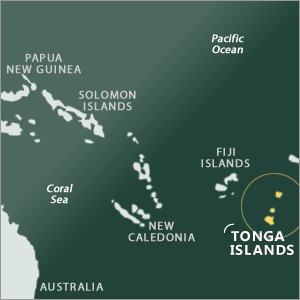

Significance
Tongan migration has generally reflected family relationships, education, religious connections, limited employment opportunities, higher wages, and the country’s close social and economic ties with New Zealand, Australia, and the United States.
Tongan migration developed from long-established Polynesian traditions of ocean travel, trade, marriage, exploration, and family connections between Pacific islands. Large-scale overseas migration began during the mid-twentieth century and increased rapidly after the 1960s. Limited land, population growth, restricted employment opportunities, education, healthcare, and the possibility of earning higher wages encouraged many Tongans to relocate. Significant Tongan communities gradually developed in New Zealand, Australia, Hawaii, California, Utah, and other parts of the United States. Migrants continued to maintain close relationships with Tonga through financial assistance, family visits, church organisations, community events, and the preservation of the Tongan language, customs, and extended-family responsibilities.
Tongan Migration Before Large-Scale Overseas Settlement
Movement between Tonga and neighbouring Pacific islands existed centuries before European contact. Skilled Polynesian navigators travelled between Tonga, Samoa, Fiji, and other islands for fishing, trade, settlement, marriage, political alliances, warfare, and family responsibilities. Tonga became an important centre of political and maritime influence in the western Pacific. European explorers, missionaries, traders, and naval vessels began arriving between the seventeenth and nineteenth centuries, creating new religious, commercial, and transportation connections. The Tongan islands were united under King George Tupou I in 1845, and Tonga became a constitutional monarchy in 1875. In 1900, Tonga entered a protected relationship with Britain while preserving its monarchy and control over its internal affairs. These developments increased Tonga’s connections with foreign countries, although overseas migration remained relatively limited before the twentieth century.
Twentieth-Century Migration
Tongan overseas migration began as a relatively small movement during the 1950s but increased considerably from the mid-1960s through the 1970s and 1980s. Many Tongans moved to New Zealand for industrial, agricultural, and service-sector employment, while others migrated to Australia and the United States through education, church connections, employment, and family reunification. Honolulu, San Francisco, Los Angeles, and Salt Lake City became important centres for Tongan settlement in the United States. Family-based migration networks helped new arrivals find accommodation, employment, churches, and community support. Tongan migrants established churches, cultural associations, sports organisations, and extended-family networks that helped preserve their language, Christian traditions, respect for elders, communal responsibilities, and close relationships with relatives living in Tonga. Money and goods sent home by overseas Tongans also became an important source of support for families, villages, churches, and the national economy.