
The Diaspora World Cup operates in some of the major cities and metro areas in
United States and
Canada. Our network of register players includes 20 cities, 200 countries, 400
teams, and 10,000
players. Join our movement to solve the world's most pressing challenges:
Illiteracy
Who We are text will be here Who We are text will be here Who We are text will
be here Who We
are text will be here Who We are text will be here Who We are text will be here
Who We are text
will be here Who We are text will be here Who We are text will be here
What We Do text will be here What We Do text will be here What We Do text will
be here What We
Do text will be here What We Do text will be here What We Do text will be here
What We Do text
will be here What We Do text will be here What We Do text will be here What We
Do text will be
here What We Do text will be here What We Do text will be here
Get Involved text will be here Get Involved text will be here Get Involved text
will be here Get
Involved text will be here Get Involved text will be here Get Involved text will
be here Get
Involved text will be here Get Involved text will be here Get Involved text will
be here Get
Involved text will be here
Education is a basic Human Right and the Diaspora World Cup global school
program focuses its
energy in some the poorest countries around the world. We build schools in some
of the poorest
countries around the worldthat historically had no adequate school structure.
Any member of the
World Diaspora has the power to end illiteracy around the world through the
power of soccer.
High-profile sport figures, global leaders, business leaders, political figure,
journalists,
activists, philanthropists, actors, and entrepreneurs united by their commitment
to the Diaspora
World Cup mission to eradicate illiteracy around the world through the power of
soccer. They serve
as role models and spread the Diaspora World Cup vision and commitment of a
world mobilized
through soccer.
Diaspora 2027: complete guide to all players | The Diaspora
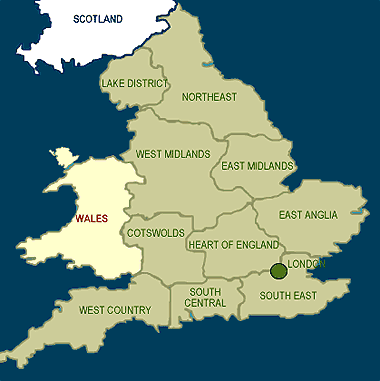
ENGLAND
Welcome to the 2028 Diaspora World Cup. Burtonsville – Laurel
Burtonsville – Laurel
Welcome to the 2028 Diaspora World Cup. Burtonsville – Laurel
The British population in the Washington DC metro (DMV) area totals 32,801 residents, making up a highly professional and robust expat and diaspora community. Unlike highly localized immigrant groups, British and English expats are fairly spread across the region, with the highest single neighborhood concentration located in Arlington, Virginia (specifically the...The British population in the Washington DC metro (DMV) area totals 32,801 residents, making up a highly professional and robust expat and diaspora community. Unlike highly localized immigrant groups, British and English expats are fairly spread across the region, with the highes...
More Information
Chelsea Official
Download The 5th Stand, Chelsea’s official mobile app, to see exclusive content, match action and all the latest news from Stamford Bridge.
More Information
Street Soccer in England
Street soccer is deeply connected with football culture in England, where children and teenagers have long enjoyed informal matches in parks, school playgrounds, residential areas, and community courts. These games provide a simple way for young players to experience football, build friendships, and develop their skills outside organised competitions.
The fast and competitive nature of street soccer helps players improve close ball control, passing, dribbling, and quick decision-making. Playing in small spaces encourages creativity, confidence, and adaptability while allowing participants to develop their own playing style through regular practice.
Street soccer continues to provide an accessible way for communities across England to enjoy football without needing professional pitches. It supports active lifestyles, brings people together, and plays an important role in introducing young players to the sport.
Street Soccer Culture in England
Football has a historic place in English society, and street soccer has traditionally been a starting point for many young players. Informal games organised by friends, schools, and local communities create opportunities for players from different backgrounds to enjoy the game together.
Skills Developed Through Street Soccer
Street soccer helps players develop dribbling, first touch, passing accuracy, agility, balance, and tactical awareness. The limited space encourages quick thinking, communication, creativity, and confident decision-making during matches.
Street Soccer and Community Development
Street soccer strengthens communities by creating positive spaces where young people can connect through football. It also helps aspiring players gain experience before moving into school teams, grassroots clubs, football academies, or organised youth programmes.
The England in the DMV Metro
The British population in the Washington DC metro (DMV) area totals 32,801 residents, making up a highly professional and robust expat and diaspora community. Unlike highly localized immigrant groups, British and English expats are fairly spread across the region, with the highest single neighborhood concentration located in Arlington, Virginia (specifically the 22207 ZIP code). Because of shared linguistic ties, the diaspora is often culturally "invisible", but it maintains a vibrant structural network of cultural groups, professional networks, and local hubs.
🏛️ Core Community & Networking Groups
British-American Business Association (BABA) Washington: The premiere professional networking organization for the diaspora. They host a wide array of business panels, an annual Christmas gala, and sporting events like polo, rugby, and the Gold Cup Steeplechase.
British Embassy Support Association (BESA): Operates out of the main British Embassy Washington. They run hyper-local neighborhood sub-groups across McLean, Falls Church, Alexandria, Bethesda, Columbia, and Annapolis, alongside dedicated groups for walking, crafting, and parents.
British Events DC: A dedicated cultural events organization that coordinates community-wide social calendar dates for British royal watchings, theater, Shakespeare fans, and soccer watch parties.
British Expat/UK Interest Group (DC, VA & MD): An active Facebook and Meetup group boasting over 1,000 members that helps expats coordinate casual local gatherings, roast beef dinners, and advice for navigating the DMV.
InterNations Washington DC Brits: A large international platform with a dedicated local circle specifically for British expats looking to settle in and network within the District.
⚽ Hubs and Hangouts
Because football (soccer) culture is a massive anchor for the English diaspora, several bars across the city serve as de facto community clubhouses for early-morning match days:
Exiles Bar: Located on 14th Street in DC, a premier destination for expats gathering to watch Premier League football.
Lucky Bar: A classic, long-standing staple in Dupont Circle known for its heavy draw of British sports fans.
The Queen's Vicar: Found in parts of the Virginia suburbs, matching the high concentrations of expats living near Portsmouth and Arlington who look for traditional pub structures.
Significance
English immigration profoundly influenced the development of the United States through colonial settlement, language, law, government, religion, agriculture, trade, industrial skills, education, and continuing family connections.
English migration to North America began during the early seventeenth century and became one of the foundations of colonial American society. Settlers included farmers, merchants, artisans, religious dissenters, labourers, servants, soldiers, and administrators seeking land, employment, religious freedom, or commercial opportunity. English communities established colonies along the Atlantic coast and introduced institutions, customs, legal traditions, and forms of government that strongly influenced the future United States. After American independence, migration from England continued through industrial employment, agriculture, trade, professional work, and family reunification. Because English language and customs already predominated in much of American society, later English immigrants often assimilated rapidly and were less likely to form separate ethnic neighbourhoods.
English Migration Before American Independence
Permanent English colonisation began at Jamestown, Virginia, in 1607, followed by Plymouth in 1620 and additional settlements throughout New England, the Chesapeake, and the southern colonies. Migrants included Puritans, Quakers, Anglicans, merchants, landowners, craftspeople, indentured servants, and families seeking religious or economic opportunities. Colonial companies received authority from the English Crown to establish settlements and create governing institutions. English settlement expanded onto lands already inhabited by Indigenous peoples, producing trade and alliances but also warfare, displacement, and territorial loss. The English colonies also became deeply connected with Atlantic slavery and the forced labour of Africans. By the American Revolution, people of English origin and their descendants formed a major part of the colonial population, and English language, laws, and customs were widely established.
Nineteenth- and Twentieth-Century Immigration
English immigration continued after Britain recognised American independence through the Treaty of Paris in 1783. During the nineteenth century, farmers, miners, textile workers, engineers, mechanics, domestic workers, merchants, and skilled artisans moved to the United States for land, employment, and higher wages. England remained one of the principal sources of American immigration before the Civil War and during the 1870s and 1880s. Migrants settled in New York, Pennsylvania, New England, the Midwest, mining regions, and expanding western states. Immigration slowed as economic conditions improved in Britain and American restrictions increased during the twentieth century. Later arrivals included war brides, academics, scientists, business executives, entertainers, healthcare workers, and other professionals. English immigrants generally integrated quickly while continuing cultural connections through churches, clubs, sports, literature, theatre, and family networks.
Lorem ipsum dolor sit amet, consectetur adipiscing elit, sed do eiusmod tempor incididunt ut
labore et dolore magna aliqua. Ut enim ad minim veniam, quis nostrud exercitation ullamco
laboris nisi ut aliquip ex ea commodo consequat. Duis aute irure dolor in
reprehenderit in voluptate velit esse cillum dolore eu fugiat nulla pariatur.