Sign In




 Facebook
 X-Twitter
 Instagram
 Linkedin
 Youtube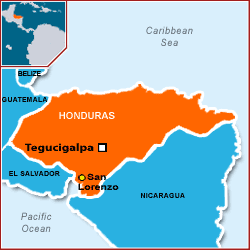

Significance
Immigration from Honduras has generally reflected Spanish colonial rule, economic hardship, political instability, natural disasters, family reunification, educational opportunities, professional employment, and humanitarian migration.
Migration from Honduras has historically been shaped by regional mobility within Central America and longstanding ties with the United States. Hondurans commonly migrated to neighboring countries, particularly Guatemala, El Salvador, and Nicaragua, as well as Mexico for agricultural work, trade, education, family connections, and seasonal employment. Overseas migration increased during the late twentieth and early twenty-first centuries as economic challenges, political instability, natural disasters, and limited employment opportunities encouraged many Hondurans to seek opportunities abroad. The United States became the principal destination through employment, family sponsorship, higher education, asylum, and humanitarian pathways. Today, Honduran immigrants form one of the largest Central American communities in the United States while maintaining strong cultural, linguistic, and family ties with their homeland.
Honduran Migration Before Independence
Before independence, Honduras formed part of the Captaincy General of Guatemala under Spanish colonial rule. Migration during the colonial period was influenced by mining, agriculture, regional commerce, missionary activities, government administration, and military service. Residents frequently travelled throughout Central America as farmers, merchants, craftsmen, labourers, students, civil servants, and members of extended families. Direct migration to the United States remained uncommon because political, educational, and commercial connections were centred primarily on Spain and neighboring Spanish colonies. Honduras declared independence from Spain on September 15, 1821, later joining the Federal Republic of Central America before becoming a fully independent republic. The United States recognized Honduras soon afterward and established diplomatic relations.
Late-Twentieth- and Early-Twenty-First-Century Immigration
Migration increased significantly after the late twentieth century as economic inequality, unemployment, political unrest, crime, and recurring natural disasters disrupted communities across Honduras. Hurricanes, including Hurricane Mitch in 1998, caused widespread destruction and displaced large numbers of people, contributing to increased migration abroad. Students, healthcare professionals, teachers, engineers, entrepreneurs, agricultural workers, and skilled labourers increasingly travelled to the United States for higher education, employment, business opportunities, or family reunification. Many others sought asylum or humanitarian protection because of violence and insecurity. In the United States, Honduran immigrants often rely on family networks, churches, community organizations, and cultural associations for assistance with housing, employment, education, language services, and social integration while preserving Spanish, Indigenous cultural traditions, traditional cuisine, music, religious practices, and close relationships with relatives in Honduras.