Sign In




 Facebook
 X-Twitter
 Instagram
 Linkedin
 Youtube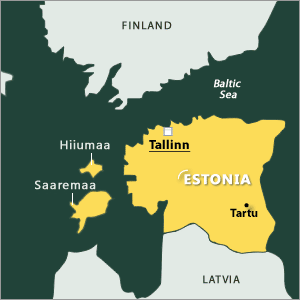

Significance
Estonian immigration to the United States has generally reflected economic change, limited agricultural opportunities, Russian imperial rule, war, Soviet occupation, political persecution, refugee displacement, education, professional employment, and family reunification.
Estonian migration to the United States became noticeable during the late nineteenth and early twentieth centuries, when Estonia formed part of the Russian Empire. Early arrivals included farmers, sailors, labourers, artisans, merchants, students, and political activists seeking land, employment, education, or greater freedom. Because Estonia was not yet an independent country, American records frequently classified these immigrants as Russians, making their exact number difficult to determine. Estonian organisations began developing by the end of the nineteenth century, and later communities formed in New York, New Jersey, Chicago, Detroit, California, and other regions. Immigration increased substantially after World War II, when refugees escaping renewed Soviet occupation were resettled in the United States.
Estonian Migration Before Independence
Before Estonia achieved independence, migration was shaped by Russian imperial administration, industrialisation, agricultural transformation, population growth, political restrictions, and limited economic opportunities. Estonians travelled abroad as farmworkers, industrial labourers, sailors, tradespeople, intellectuals, and students. Some settled in American cities, while others established small agricultural communities. The first organised Estonian American groups appeared during the 1890s; an Estonian Lutheran congregation was established in Fort Pierre, South Dakota, in 1897, and an Estonian-language newspaper appeared during the same year. Immigrants created churches, societies, newspapers, and social networks that helped newcomers obtain employment and preserve their language and traditions. Estonia declared independence in 1918, and the United States formally recognised the country and established diplomatic relations on July 28, 1922.
Twentieth-Century Immigration
Estonian immigration changed dramatically during World War II. The Soviet Union occupied and annexed Estonia in 1940, Nazi Germany controlled the country from 1941 to 1944, and Soviet forces returned in 1944. Tens of thousands fled to Germany, Sweden, and other European countries rather than remain under Soviet rule. Many lived in displaced-persons camps before being admitted to the United States after the war. These refugees included professionals, academics, artists, former officials, skilled workers, farmers, and families. They established churches, schools, newspapers, cultural centres, and organisations that preserved Estonian identity and supported the restoration of independence. The United States never recognised Estonia’s forced incorporation into the Soviet Union and recognised the restoration of its independence in 1991.