 Sign In




 Facebook
 X-Twitter
 Instagram
 Linkedin
 Youtube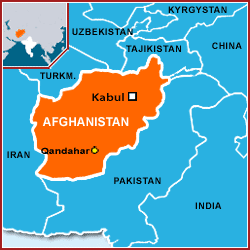
More Information
More Information
Street Soccer in Afghanistan
Street soccer is a popular way for young people in Afghanistan to enjoy football, particularly in residential neighbourhoods, village streets, school courtyards, and open community spaces. Children and teenagers frequently organise friendly matches after school and during weekends, using simple goals and any available playing area.
Despite limited access to professional football facilities in many areas, street soccer remains an important part of everyday recreation. Playing in compact spaces encourages creativity, accurate passing, quick movement, and strong ball control while helping players adapt to different playing conditions.
Street soccer offers an affordable opportunity for young people to stay active, build friendships, and develop a passion for football within their local communities.
Street Soccer Culture in Afghanistan
Football has continued to grow in popularity across Afghanistan, and street soccer plays a key role in introducing young players to the game. Informal matches are often organised by neighbourhood groups, classmates, and local communities, creating an inclusive environment where players of different ages can participate together.
Skills Developed Through Street Soccer
Regular street soccer helps players improve first touch, dribbling, short passing, agility, awareness, and decision-making. The unpredictable nature of informal games also encourages creativity, teamwork, and confidence on the ball.
Street Soccer and Community Development
Street soccer provides a positive recreational activity that brings communities together and encourages healthy lifestyles among young people. It also serves as an early pathway for talented players who later join school teams, local football clubs, or community football programmes.
The Afghanistan in the DMV Metro

- Northern Virginia Hubs: Prior to the 2021 Kabul evacuations, baseline estimates from the George Mason University Institute for Immigration Research recorded roughly 17,600+ Afghan immigrants in the DC-Baltimore metro region, with high concentrations in Fairfax County (6,863), Prince William County (3,919), and Alexandria City (1,832). Wider community estimates including ancestry place the broader regional figure well past 30,000.
- Integration and Citizenship: Roughly 49% of the area's foreign-born Afghans are naturalized U.S. citizens, performing slightly higher in English proficiency and naturalization rates compared to Afghan populations in other parts of the United States.
- Newcomer Influx: Following Operation Allies Welcome and the 2021 withdrawal, thousands of new Afghan evacuees settled into the DMV area.
- Support Networks: Grassroots organizations, regional networks (such as local community groups and online spaces like the Afghans Living in DC Area networks), and academic entities - including American University's Immigration Lab - actively study and assist the socioeconomic integration, educational attainment, and legal status challenges faced by recent arrivals.
- Resettlement Hurdles: Newly arrived families frequently navigate systemic hurdles including long-term housing affordability, employment placement matching their skill sets, English language training, and managing temporary humanitarian parole or legal limbo.
Significance
Afghan immigration to the United States has increased mainly during periods of war, political instability, persecution, and government collapse in Afghanistan. Unlike many immigrants who moved primarily for employment or financial opportunities, a large number of Afghans arrived in search of safety and protection. During the United States’ involvement in Afghanistan, many Afghans worked as interpreters, translators, contractors, security personnel, medical workers, civil-society professionals, and government employees. These connections later placed some workers and their families at risk. Afghan immigrants have contributed to American society through business, medicine, education, engineering, public service, transportation, technology, food, and the arts. However, many families have also faced challenges involving language, housing, employment, family separation, immigration status, and recognition of qualifications earned in Afghanistan.
Early Afghan Immigration
Afghan immigration to the United States remained relatively limited during the first half of the twentieth century. Early Afghan arrivals mainly included students, diplomats, government representatives, businesspeople, academics, and professionals who travelled to the United States for education, official work, or employment opportunities. Many of these individuals did not originally intend to settle permanently and continued to maintain close relationships with Afghanistan. Small Afghan communities gradually developed in major metropolitan areas such as New York, Washington, D.C., and San Francisco, where universities, international institutions, government offices, and professional opportunities were available. Although the Afghan population was initially small and widely dispersed, immigrants created family networks, cultural associations, restaurants, grocery stores, religious institutions, and informal community groups that later provided valuable assistance and support to newly arriving Afghan families.
Migration after the Soviet Invasion
Afghan migration to the United States increased significantly after the political revolution of 1978 and the Soviet invasion of Afghanistan in December 1979. War, political repression, arrests, violence, and insecurity forced millions of Afghans to leave their homes, with most initially seeking refuge in neighbouring Pakistan and Iran. A smaller number were later permitted to settle in the United States and other Western countries. Afghan immigrants arriving during the 1980s included former government officials, military officers, teachers, doctors, engineers, academics, business owners, and members of prominent families. Although many possessed professional qualifications and valuable experience, their Afghan degrees were not always recognised in the United States. Consequently, some accepted lower-skilled jobs while learning English, meeting licensing requirements, supporting relatives abroad, and establishing the institutions that formed strong Afghan American communities.
Latest Fixtures & Results
| 04.03.2027 |  |
Sweden | - |  |
Afghanistan |
| 04.10.2027 | |
Afghanistan | - |  |
Malta |
| 04.17.2027 |  |
Bangladesh | - | |
Afghanistan |
| 04.24.2027 | |
Afghanistan | - |  |
Montenegro |
| 05.01.2027 |  |
Burma | - | |
Afghanistan |
| 05.08.2027 |  |
Switzerland | - | |
Afghanistan |
| 05.15.2027 | |
Afghanistan | - |  |
Costa R. |
| 05.22.2027 |  |
Algeria | - | |
Afghanistan |
| 05.29.2027 | |
Afghanistan | - |  |
Spain |
