 Sign In




 Facebook
 X-Twitter
 Instagram
 Linkedin
 Youtube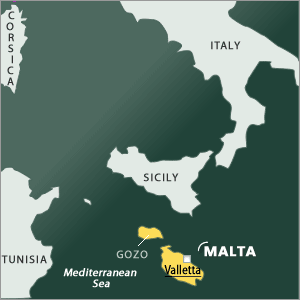
More Information
More Information
Street Soccer in Malta
Street soccer is a popular activity in Malta, where children and teenagers regularly enjoy informal football matches in neighbourhood streets, school playgrounds, public parks, village squares, and community sports courts. These games give young players a fun opportunity to stay active, spend time with friends, and improve their football skills outside organised training.
The compact playing spaces encourage quick passing, close ball control, creative dribbling, and intelligent movement. The fast rhythm of street soccer helps players develop confidence, teamwork, and technical ability while adapting to different opponents and playing conditions during regular matches.
Street soccer provides an accessible and affordable way for communities across Malta to enjoy football without requiring professional stadiums or large playing fields. It promotes healthy lifestyles, strengthens local friendships, and encourages young people to continue their passion for the sport.
Street Soccer Culture in Malta
Football is one of the most popular sports in Malta, and street soccer has long been a favourite way for children to experience the game. Friendly matches organised by schools, neighbourhood groups, and local communities create an inclusive atmosphere where players of all ages and abilities can participate.
Skills Developed Through Street Soccer
Street soccer helps players improve dribbling, first touch, passing accuracy, agility, balance, ball control, and awareness. Regular play also develops communication, creativity, confidence, and the ability to make quick decisions in fast-paced situations.
Street Soccer and Community Development
Street soccer brings communities together through football while encouraging teamwork, positive youth participation, and active outdoor recreation. It also provides aspiring players with valuable experience before progressing to school teams, local football clubs, academies, or organised youth football programmes.
The MALTA in the DMV Metro

The Maltese diaspora in the DMV (Washington, D.C., Maryland, and Virginia) is a very small, highly specialized community centered primarily around diplomatic, academic, international, and professional networks. Unlike the historic Maltese-American concentrations in Detroit and New York, the DMV population does not form a distinct ethnic neighborhood and instead relies heavily on institutional and cross-European connections.
Community Hubs and Institutional Presence
-
The Embassy of the Republic of Malta: Located in Washington, D.C., the Embassy serves as the principal diplomatic and community anchor for Maltese nationals in the region. It provides consular services and hosts receptions and national celebrations, including Malta's Independence Day and Republic Day.
-
Professional & International Networks: The DMV's Maltese population is closely connected to Washington's diplomatic and international ecosystem, with representation among government officials, academics, international-development professionals, maritime and aviation specialists, and consultants working with multilateral institutions.
-
Maltese-American Networks: Because there is no large local Maltese neighborhood, residents maintain connections through national Maltese-American organizations and digital networks that facilitate heritage activities, social relationships, and connections with Maltese communities elsewhere in the United States.
Cultural and Social Dynamics
-
Passport DC & Cultural Diplomacy: The annual Passport DC / Around the World Embassy Tour provides Malta with one of its most visible opportunities for public cultural outreach. Embassy programming can highlight Malta's Mediterranean heritage, historic temples, Knights Hospitaller legacy, traditional crafts, cuisine, and tourism.
-
Italian & Mediterranean Connections: Maltese identity has strong historical and cultural links to Sicily and southern Italy. Local Maltese residents therefore often participate in broader Italian, Mediterranean, and European cultural networks rather than maintaining separate institutions.
-
British & European Connections: Malta's English-speaking environment and historical relationship with Britain also create connections with British and wider European professional communities in Washington.
-
Heritage Preservation: With a very small local population and no concentrated Maltese commercial district, cultural preservation is primarily maintained through family networks, national organizations, embassy events, and connections to the wider Maltese-American community.
-
Community Structure: The DMV Maltese population is best understood as a network-based micro-diaspora rather than a geographic enclave, with the Embassy functioning as its central institutional anchor and broader European networks providing much of its social and cultural infrastructure.
Significance
Immigration from Malta has generally reflected British colonial rule, economic opportunity, educational advancement, professional employment, family reunification, international business, maritime industries, and skilled migration.
Migration from Malta has historically been shaped by its strategic location in the Mediterranean and its longstanding maritime traditions. During the nineteenth and twentieth centuries, many Maltese emigrated to the United Kingdom, Australia, Canada, and the United States in search of employment, improved living conditions, and educational opportunities. Overseas migration expanded after the Second World War as economic modernization, professional careers, and family sponsorship encouraged further international mobility. Today, Maltese immigrants in the United States include students, healthcare professionals, engineers, academics, entrepreneurs, business professionals, and skilled workers who maintain strong cultural, linguistic, and family ties with their homeland.
Maltese Migration Before Independence
Before independence, Malta was administered as a British colony after 1814, although its history included periods of rule by the Knights of St. John, France, and other European powers. Migration during the colonial period was influenced by maritime trade, shipbuilding, dockyard employment, military service, government administration, education, and regional commerce. Many Maltese travelled to the United Kingdom and other parts of the British Empire as sailors, merchants, craftsmen, teachers, students, civil servants, and skilled labourers. Direct migration to the United States increased during the late nineteenth and early twentieth centuries, although most overseas migration remained within the British Commonwealth. Malta gained independence from the United Kingdom on September 21, 1964, and the United States recognized the new nation shortly thereafter before establishing diplomatic relations.
Late-Twentieth- and Early-Twenty-First-Century Immigration
Migration evolved after independence as Malta experienced economic growth, expanding higher education, and greater integration into the global economy. Students, physicians, engineers, scientists, academics, entrepreneurs, information technology specialists, financial professionals, and business executives increasingly travelled to the United States for university education, specialized employment, research, investment, or family reunification. Academic exchange programs, multinational companies, and international business partnerships have continued to support migration in recent decades. In the United States, Maltese immigrants often rely on family networks, churches, cultural associations, alumni organizations, and professional groups for support with housing, employment, education, and community integration while preserving Maltese, English, traditional cuisine, religious traditions, cultural heritage, and close relationships with relatives in Malta.
Latest Fixtures & Results
| 04.03.2028 |  |
Malta | - |  |
Montenegro |
| 04.10.2028 |  |
Afghanistan | - | |
Malta |
| 04.17.2028 | |
Malta | - |  |
Switzerland |
| 04.24.2028 |  |
Costa R. | - | |
Malta |
| 05.01.2028 | |
Malta | - |  |
Algeria |
| 05.08.2028 |  |
Spain | - | |
Malta |
| 05.15.2028 | |
Malta | - |  |
Sweden |
| 05.22.2028 | |
Malta | - |  |
Burma |
| 05.29.2028 |  |
Bangladesh | - | |
Malta |
