
Street soccer is a popular and deeply rooted activity in Pakistan, where children and teenagers regularly gather in neighbourhood streets, school grounds, local parks, village fields, and community spaces to play informal football matches. These games provide a fun and affordable way for young players to stay active, develop their skills, and enjoy football with friends.
The energetic nature of street soccer encourages quick passing, close ball control, creative dribbling, and fast movement. Playing in limited spaces helps participants improve their technique, confidence, teamwork, and decision-making while adapting to different playing surfaces and match situations.
Street soccer provides an accessible way for communities across Pakistan to enjoy football without requiring professional facilities or expensive equipment. It promotes healthy lifestyles, strengthens social connections, and inspires many young people to continue their passion for the sport.
Football has a strong following in many regions of Pakistan, and street soccer is often where many children first experience the excitement of the game. Informal matches organised by friends, schools, and neighbourhood communities create a lively environment where players of different ages and abilities can participate.
Street soccer helps players improve dribbling, first touch, passing accuracy, agility, balance, ball control, and awareness. Regular games also develop communication, creativity, confidence, and the ability to make quick decisions during fast-paced play.
Street soccer brings communities together through football while encouraging teamwork, positive youth participation, and active lifestyles. It also provides aspiring players with valuable experience before progressing to school teams, local football clubs, academies, futsal programmes, or organised youth football competitions.
The Pakistani diaspora in the DMV (District of Columbia, Maryland, and Virginia) is a large, affluent, and highly engaged community comprising more than 40,000 residents across the broader Washington, D.C., and Baltimore metropolitan areas. Unlike older Pakistani-American enclaves in the Northeast, the DMV community is characterized by a strong concentration of technology professionals, physicians, federal employees, defense consultants, entrepreneurs, and political and civic leaders, with major population centers in Northern Virginia and suburban Maryland.
Embassy Hub: The Embassy of Pakistan in Washington, D.C. serves as an important diplomatic and cultural anchor for the regional community. It organizes national-day celebrations, cultural programs, diaspora outreach, and consular services while maintaining connections between Pakistani-Americans and Pakistan.
Civic & Political Network: The Pakistani-American Public Affairs Committee (PAKPAC) has developed a significant presence in the DMV. Its local chapter brings together Pakistani-American professionals, business leaders, and community organizers through political town halls, congressional engagement, and advocacy initiatives.
Entrepreneurship & Professional Networks: Organizations such as OPEN Washington, D.C. connect Pakistani-American entrepreneurs, technology executives, investors, and professionals. These networks provide opportunities for mentorship, business development, investment, and professional networking across Northern Virginia, Maryland, and Washington, D.C.
Pakistan Festival: The annual Pakistan Festival in Manassas, Virginia, at the Prince William County Fairgrounds, is one of the region's largest Pakistani cultural celebrations. Thousands of attendees gather for Pakistani food, fashion, music, entertainment, shopping, and family activities, creating a major annual meeting point for the diaspora.
Pakistan Independence Day: Around August 14, Pakistani-American organizations, community leaders, and businesses across the DMV organize flag-hoisting ceremonies, cultural programs, musical performances, dinners, and large-scale Independence Day celebrations.
Pakistan Lifestyle & Trade Expos: Events such as the Pakistan Lifestyle Expo at the Dulles Expo Center bring Pakistani fashion, home décor, food, jewelry, and lifestyle brands directly to the DMV market. These exhibitions function as both shopping destinations and commercial networking platforms for Pakistani entrepreneurs and importers.
The community's social life is reinforced by Pakistani restaurants, bakeries, grocery stores, banquet halls, and event venues concentrated throughout Northern Virginia and suburban Maryland.
Northern Virginia: Areas around Manassas, Woodbridge, Sterling, Chantilly, Herndon, and Ashburn contain particularly strong Pakistani-American commercial networks, including restaurants, halal markets, clothing businesses, and family-oriented event spaces.
Maryland: Montgomery County and the broader suburban Maryland corridor provide another major Pakistani-American commercial and social base, with Pakistani restaurants, grocery stores, professional services, and community organizations serving residents from the Washington and Baltimore metropolitan areas.
Community Events: Large banquet halls and metropolitan event venues regularly host Pakistani weddings, musical nights, comedy shows, fundraising dinners, and Independence Day galas, often featuring performers and entertainers from Pakistan.
Overall, the DMV Pakistani community combines cultural institutions, political advocacy, entrepreneurship, and a sophisticated professional network. Its concentration of highly educated professionals and business owners, combined with major festivals and a growing Pakistani commercial ecosystem, makes the region one of the most prominent Pakistani-American cultural and economic centers in the United States.
Immigration from Pakistan has generally reflected the partition of British India, educational advancement, professional employment, economic opportunity, family reunification, skilled migration, international business, and humanitarian migration.
Migration from Pakistan has historically been shaped by the partition of British India, political developments, expanding educational opportunities, and global labor demand. Pakistanis have commonly migrated to the Gulf countries, the United Kingdom, North America, and Europe for employment, higher education, business, and family reunification. Migration to the United States increased significantly after the mid-twentieth century as students, physicians, engineers, scientists, entrepreneurs, and other skilled professionals pursued academic and professional opportunities. Today, Pakistani immigrants have established one of the largest and most diverse South Asian communities in the United States while maintaining strong cultural, linguistic, religious, and family ties with Pakistan.
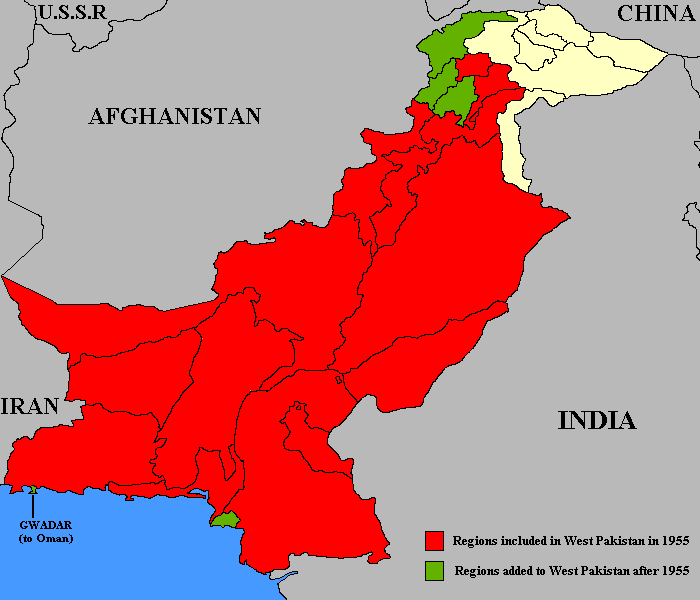
Before independence, the territory of present-day Pakistan formed part of British India under British colonial administration. Migration during the colonial period was influenced by agriculture, trade, military service, government administration, railway construction, higher education, and regional commerce. Residents travelled throughout the Indian subcontinent and the British Empire as farmers, merchants, teachers, students, civil servants, soldiers, and skilled workers. Direct migration to the United States remained relatively limited because political, educational, and commercial connections were centred primarily on the United Kingdom and other British territories. Pakistan became an independent state on August 14, 1947, following the partition of British India, and the United States recognized the new nation soon afterward before establishing diplomatic relations.
Migration increased after independence as educational opportunities, professional careers, and expanding global economic connections encouraged many Pakistanis to seek opportunities abroad. Political developments, economic reforms, and family sponsorship further contributed to migration, while U.S. universities and employers attracted growing numbers of highly skilled professionals. Students, physicians, engineers, scientists, academics, entrepreneurs, information technology specialists, business professionals, and researchers increasingly travelled to the United States for university education, specialized employment, scientific research, investment, or family reunification. In the United States, Pakistani immigrants often rely on family networks, mosques, cultural associations, community organizations, alumni groups, and professional societies for support with housing, employment, education, and community integration while preserving Urdu, English, Punjabi, Sindhi, Pashto, and other regional languages, traditional cuisine, cultural heritage, religious practices, and close relationships with relatives in Pakistan.

Sign In