 Sign In




 Facebook
 X-Twitter
 Instagram
 Linkedin
 Youtube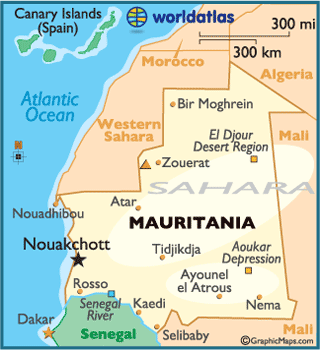
More Information
More Information
Street Soccer in Mauritania
Street soccer is a popular recreational activity in Mauritania, where children and teenagers regularly gather in neighbourhood streets, village squares, school grounds, sandy open spaces, and community fields to play informal football matches. These games provide a fun and affordable way for young people to stay active while improving their football skills with friends.
The open playing areas and fast-paced style of street soccer encourage players to develop close ball control, accurate passing, creative dribbling, and quick decision-making. Playing on different surfaces helps participants become more adaptable while strengthening confidence, teamwork, and technical ability through regular matches.
Street soccer remains one of the most accessible forms of football across Mauritania, requiring minimal equipment while bringing communities together through the sport. It promotes healthy lifestyles, encourages positive youth participation, and inspires many young players to pursue football at higher levels.
Street Soccer Culture in Mauritania
Football is widely enjoyed throughout Mauritania, and street soccer is often where many children first learn the fundamentals of the game. Informal matches organised by schools, neighbours, and local communities create a welcoming atmosphere where players of different ages and abilities can participate.
Skills Developed Through Street Soccer
Street soccer helps players improve dribbling, first touch, passing accuracy, agility, balance, ball control, and awareness. Regular games also strengthen communication, creativity, confidence, and the ability to make quick decisions under pressure.
Street Soccer and Community Development
Street soccer strengthens communities by bringing people together through football while encouraging teamwork, active lifestyles, and positive youth engagement. It also provides aspiring players with valuable experience before progressing to school teams, local football clubs, academies, or organised youth football programmes.
The MAURITANIA in the DMV Metro

The Mauritanian diaspora in the DMV (Washington, D.C., Maryland, and Virginia) is a compact, tightly connected, and politically engaged micro-diaspora. Rather than forming a large geographic enclave, the community is concentrated around diplomatic institutions, civic organizations, human-rights advocacy, professional networks, and connections with broader West African and Francophone communities.
Community Hubs and Institutional Presence
-
The Embassy of the Islamic Republic of Mauritania: Located in Washington, D.C., the Embassy serves as the primary diplomatic and administrative anchor for Mauritanians in the region. It supports bilateral relations, economic engagement, trade initiatives, and official community outreach.
-
Mauritanian Community in the DMV: The local community association provides an important social and civic framework for Mauritanian residents. Its activities include cultural gatherings, newcomer support, community integration, and mutual assistance for families facing emergencies.
-
Professional & Policy Networks: The DMV community includes diplomats, academics, international-development professionals, researchers, and policy specialists, reflecting Washington's broader concentration of African-focused institutions and international organizations.
Cultural and Social Dynamics
-
Human Rights & Civic Advocacy: Political and human-rights issues in Mauritania play a significant role in diaspora activity. Washington, D.C. provides an important platform for activists to organize demonstrations, educational events, and advocacy campaigns concerning civil rights and political inclusion.
-
West African & Francophone Connections: Because the Mauritanian community is relatively small, residents frequently participate in larger West African and Francophone networks throughout the DMV. These relationships provide additional cultural, religious, professional, and social infrastructure.
-
Passport DC & Embassy Outreach: The annual Passport DC / Around the World Embassy Tour offers an important public platform for Mauritanian cultural representation. Embassy programming can highlight Mauritania's Saharan and West African heritage through traditional crafts, textiles, music, hospitality, and the country's distinctive mint-tea tradition.
-
Cultural & Culinary Overlap: Mauritanian families often connect with neighboring West African communities for food and social activities. Senegalese and other regional cuisines provide familiar culinary traditions because of longstanding cultural and geographic connections across the Senegal River region.
-
Community Identity: The DMV Mauritanian community functions less as a geographically concentrated neighborhood and more as a network-based diaspora, linking families, diplomats, activists, professionals, and West African cultural organizations across Maryland, Virginia, and Washington, D.C.
Significance
Immigration from Mauritania has generally reflected French colonial rule, economic opportunity, educational advancement, professional employment, political instability, family reunification, regional mobility, and humanitarian migration.
Migration from Mauritania has historically been shaped by its location in Northwest Africa and longstanding regional connections across the Sahel and the Maghreb. Mauritanians have commonly migrated to neighboring countries, including Senegal, Mali, Morocco, and Algeria, for trade, pastoral livelihoods, education, employment, and family ties. Overseas migration expanded after independence as students, healthcare professionals, academics, entrepreneurs, government officials, and skilled workers sought higher education and career opportunities in France, the United States, and other countries. Political tensions, economic challenges, drought, and periods of displacement have also influenced migration patterns. Today, Mauritanian immigrants in the United States maintain strong cultural, linguistic, and family ties with their homeland.
Mauritanian Migration Before Independence
Before independence, Mauritania formed part of French West Africa as the French Colony of Mauritania under French colonial administration. Migration during the colonial period was influenced by nomadic pastoralism, trans-Saharan trade, agriculture, fishing, government administration, military recruitment, and regional commerce. Residents frequently travelled throughout West and North Africa as herders, traders, fishermen, students, civil servants, and members of extended families. Direct migration to the United States remained relatively limited because political, educational, and commercial connections were centred primarily on France and neighboring French territories. Mauritania gained independence from France on November 28, 1960, and the United States recognized the new nation shortly thereafter before establishing diplomatic relations.
Late-Twentieth- and Early-Twenty-First-Century Immigration
Migration increased after independence as educational opportunities, economic conditions, and expanding professional careers encouraged many Mauritanians to seek opportunities abroad. Political instability, ethnic tensions, drought, and human rights concerns also contributed to international migration and, in some cases, asylum and refugee movements. Students, physicians, engineers, scientists, academics, entrepreneurs, information technology specialists, business professionals, and researchers increasingly travelled to the United States for university education, specialized employment, research, investment, family reunification, or humanitarian protection. In the United States, Mauritanian immigrants often rely on family networks, mosques, cultural associations, community organizations, and professional groups for support with housing, employment, education, language services, and community integration while preserving Arabic, Pulaar, Soninke, Wolof, and other local languages, traditional cuisine, cultural heritage, religious practices, and close relationships with relatives in Mauritania
Latest Fixtures & Results
| 04.03.2027 |  |
Qatar | - |  |
Mauritania |
| 04.10.2027 | |
Mauritania | - |  |
Tajikistan |
| 04.17.2027 |  |
Cape V. | - | |
Mauritania |
| 04.24.2027 | |
Mauritania | - |  |
Mauritius |
| 05.01.2027 |  |
Palestine | - | |
Mauritania |
| 05.08.2027 |  |
Oman | - | |
Mauritania |
| 05.15.2027 | |
Mauritania | - |  |
Singapore |
| 05.22.2027 |  |
Madagascar | - | |
Mauritania |
| 05.29.2027 | |
Mauritania | - |  |
Chad |
