 Sign In




 Facebook
 X-Twitter
 Instagram
 Linkedin
 Youtube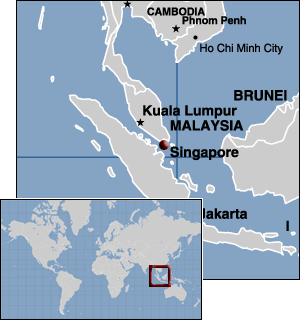
More Information
More Information
Street Soccer in Singapore
Street soccer is a popular recreational activity in Singapore, where children, teenagers, and adults regularly play informal football matches in neighbourhood courts, school playgrounds, public parks, community sports facilities, and dedicated futsal courts. These games provide an enjoyable way for players to stay active, improve their football skills, and connect with friends in a fast-paced environment.
The compact playing spaces commonly used for street soccer encourage quick passing, close ball control, creative dribbling, and intelligent movement. Regular matches help participants improve technical ability, teamwork, confidence, and decision-making while adapting to high-tempo play.
Street soccer offers an accessible and affordable way for communities across Singapore to enjoy football without requiring large stadiums or professional facilities. It promotes healthy lifestyles, encourages social interaction, and inspires many young players to continue developing their passion for the sport.
Street Soccer Culture in Singapore
Football is widely enjoyed in Singapore, and street soccer is often where many young players first develop their love for the game. Informal matches organised by schools, neighbourhood groups, and community organisations create an inclusive environment where players of different ages and skill levels can participate throughout the year.
Skills Developed Through Street Soccer
Street soccer helps players improve dribbling, first touch, passing accuracy, shooting technique, agility, balance, ball control, and tactical awareness. Regular games also strengthen communication, creativity, confidence, and the ability to make quick decisions under pressure.
Street Soccer and Community Development
Street soccer plays an important role in bringing communities together through football. It encourages teamwork, positive youth participation, and active lifestyles while providing aspiring players with valuable experience before progressing to school teams, local football clubs, academies, futsal programmes, or organised youth football competitions.
The SINGAPORE in the DMV Metro

- The Embassy of Singapore: Located on International Place NW, the Embassy of the Republic of Singapore serves as the absolute administrative and cultural core for local families. The embassy handles essential passport renewals and consular affairs, while routinely coordinating high-profile business briefings.
- The AUKUS and Defense Pipeline: Reflecting Singapore's strategic defense relationship with the United States, a notable segment of the local diaspora consists of military personnel and defense tech contractors. They work directly alongside the Pentagon and major aerospace firms in Northern Virginia to coordinate regional maritime security and advanced tactical training.
- Multilateral Leadership: Many adult members of the diaspora are employed by downtown D.C. institutions such as the World Bank and the International Monetary Fund (IMF), directing economic, climate, and infrastructural portfolios for the Asia-Pacific region.
- The Singapore American Association (SAA) - DC Chapter: Operating as a long-standing civic anchor across the region, this network focuses heavily on community scaffolding. They organize professional networking mixers, coordinate local family outreach, and host cultural celebrations to keep Singaporean traditions alive for second-generation children.
- Digital Support Networks: The everyday social tissue of the diaspora relies heavily on active digital coordination. Grassroots spaces like the Singaporeans in DC networks function as essential multi-lingual hubs. This network allows newly arrived families to share job openings, coordinate school district navigation, and share housing leads across the tri-state area.
- National Day at the Embassy: Every August, the Singapore Embassy opens its doors to host the official National Day celebration. Drawing hundreds of local expats, the mega-event features a meticulously curated open-air marketplace mirroring Singapore's iconic Hawker Centers. Local families and visiting dignitaries gather to share authentic plates of Chicken Rice, Laksa, Satay skewers, Char Kway Teow, and Kaya toast.
- Shared Southeast Asian Spaces: While standalone brick-and-mortar Singaporean restaurants in the DMV are rare, the community actively maintains its culinary heritage through specialized catering networks and shared Malaysian-Singaporean dining spaces. Expats frequently frequent regional Southeast Asian hubs across Rockville, MD, and Fairfax, VA, to source authentic spices and pandan ingredients.
- Washington, D.C. Proper: Strongly concentrated near Foggy Bottom, DuPont Circle, and the NW office corridors, primarily comprising active diplomats, international law practitioners, and multilateral bank staff.
- Northern Virginia (Fairfax County): Highly favored by corporate tech professionals, aerospace contractors, and military families residing in McLean, Arlington, and Reston due to proximity to the regional technology corridor.
- Montgomery County, MD: Pockets of Singaporean-born biotechnology researchers and academic scholars living in Bethesda and Rockville, heavily connected to federal health research institutes.
Significance
Singaporean migration has generally reflected colonial trade, overseas education, professional employment, international business, family reunification, and the country’s close connections with global commercial and academic networks.
Migration from Singapore to the United States has remained comparatively limited because Singapore developed strong educational institutions, a prosperous economy, and extensive employment opportunities of its own. Early Singaporean arrivals mainly included students, merchants, sailors, diplomats, academics, and professionals travelling for education, commerce, or specialised work. Later migrants included engineers, scientists, doctors, technology workers, financial professionals, entrepreneurs, and relatives joining established families. Singaporean communities in the United States are generally small and widely dispersed, particularly around major universities, financial centres, and technology regions. They preserve English, Mandarin, Malay, Tamil, religious traditions, multicultural food, national celebrations, and close professional and family connections with Singapore.
Singaporean Migration Before Independence
Before independence, Singapore was primarily a destination for migration rather than a major source of emigrants. Its development as a British trading port attracted successive waves of people from China, India, the Malay Archipelago, Europe, and other regions. Migrants worked as merchants, dockworkers, sailors, domestic employees, labourers, moneylenders, administrators, artisans, and professionals, helping create Singapore’s multicultural population. Some residents travelled to Britain, Malaya, China, India, Australia, and the United States for education, trade, government service, or maritime employment, but permanent settlement in America remained uncommon. Commercial connections with the United States began during the nineteenth century, and an American consulate was established in Singapore in 1836.
Late-Twentieth- and Early-Twenty-First-Century Immigration
Singapore became part of Malaysia in 1963 and emerged as an independent sovereign state in August 1965. The United States recognised Singapore on August 11, 1965, and established formal diplomatic relations and an embassy the following year. As Singapore developed into an international centre for finance, shipping, manufacturing, technology, education, and trade, movement to the United States increasingly involved university study, corporate assignments, scientific research, entrepreneurship, professional employment, and family reunification. Many Singaporeans abroad return after completing their studies or work assignments, while others maintain transnational careers between Asia and North America. At the same time, Singapore continues to depend heavily on international migration to support its labour force, population growth, and global economic competitiveness.
Latest Fixtures & Results
| 04.03.2028 |  |
Singapore | - |  |
Madagascar |
| 04.10.2028 |  |
Chad | - | |
Singapore |
| 04.17.2028 |  |
Qatar | - | |
Singapore |
| 04.24.2028 | |
Singapore | - |  |
Tajikistan |
| 05.01.2028 |  |
Cape V. | - | |
Singapore |
| 05.08.2028 | |
Singapore | - |  |
Mauritius |
| 05.15.2028 |  |
Mauritania | - | |
Singapore |
| 05.22.2028 | |
Singapore | - |  |
Oman |
| 05.29.2028 |  |
Palestine | - | |
Singapore |
