Sign In




 Facebook
 X-Twitter
 Instagram
 Linkedin
 Youtube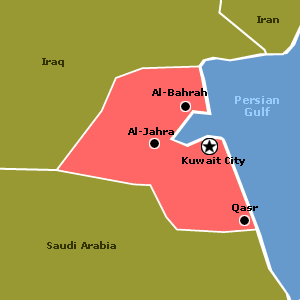
More Information
More Information
Street Soccer in Kuwait
Street soccer is a popular recreational activity in Kuwait, where children and teenagers regularly play informal football matches in neighbourhood parks, school playgrounds, public courts, and community sports areas. These games offer young players an enjoyable way to stay active, spend time with friends, and improve their football skills outside organised competitions.
Playing on smaller courts encourages quick passing, close ball control, agile movement, and fast decision-making. The energetic style of street soccer helps players develop confidence, creativity, and teamwork while adapting to different opponents and playing conditions through regular practice.
Street soccer provides an accessible and affordable way for communities across Kuwait to enjoy football without requiring professional stadiums or large playing fields. It promotes healthy lifestyles, strengthens neighbourhood connections, and inspires many young people to continue their involvement in the sport.
Street Soccer Culture in Kuwait
Football is one of the most popular sports in Kuwait, and street soccer is often where many children first build their passion for the game. Informal matches organised by schools, neighbours, and local communities create a friendly environment where players of different ages and skill levels can participate.
Skills Developed Through Street Soccer
Street soccer helps players improve dribbling, first touch, passing accuracy, agility, balance, ball control, and awareness. Regular games also strengthen communication, creativity, confidence, and the ability to make quick decisions during fast-paced matches.
Street Soccer and Community Development
Street soccer brings communities together through football while encouraging teamwork, active lifestyles, and positive youth participation. It also provides aspiring players with valuable experience before progressing to school teams, local football clubs, academies, or organised youth football programmes.
The KUWAIT in the DMV Metro

The Kuwaiti diaspora in the DMV (Washington, D.C., Maryland, and Virginia) is a relatively small, young, and institutionally supported Gulf Arab community. Unlike larger permanent immigrant populations, the local Kuwaiti presence is strongly shaped by government-sponsored students, military trainees, diplomats, and other temporary professional assignments. Community life therefore revolves around the Embassy, educational institutions, student organizations, and broader Arab cultural networks.
Community Hubs and Institutional Presence
-
The Embassy of the State of Kuwait: Located in Washington, D.C., the Embassy serves as the primary diplomatic and civic anchor for Kuwaitis in the region. It provides consular services while organizing community outreach, cultural programming, official receptions, and national celebrations.
-
Kuwait Cultural Office – Washington, D.C.: The Cultural Office serves as a major educational support institution for Kuwaiti students studying in the United States. It assists with university placements, academic advising, scholarship administration, and coordination among Kuwaiti students throughout the East Coast.
-
National Union of Kuwaiti Students (NUKS): The U.S. branch provides a student-centered social and professional network. Kuwaiti students at universities such as Georgetown University, George Washington University, and the University of Maryland can use the network for peer mentoring, professional development, career activities, and community events.
Cultural and Social Dynamics
-
Student & Professional Orientation: The community has a particularly young and mobile demographic, with many residents in the DMV temporarily for education, military training, diplomacy, or professional assignments.
-
Kuwaiti & Gulf Cultural Preservation: Community events emphasize Kuwaiti traditions, Arabic language, hospitality, food, textiles, traditional clothing, and national celebrations. Embassy programming provides an important public platform for showcasing Kuwaiti heritage.
-
Khaleeji Cultural Networks: Because the permanent Kuwaiti population is relatively small, residents frequently participate in wider Gulf and Arab-American networks, sharing social, religious, professional, and cultural spaces with Saudi, Emirati, Qatari, Bahraini, Omani, and other Arab communities.
-
Kuwaiti Cuisine: Gulf cuisine provides an important social connection to home. Kuwaiti and broader Khaleeji dishes, Arabic coffee, karak tea, rice and meat dishes, and traditional sweets feature prominently in community gatherings and regional restaurants.
-
Traditional Arts & Crafts: Cultural programming involving Sadu weaving, textiles, crafts, and Bedouin heritage provides another mechanism for preserving Kuwaiti identity and introducing the culture to the wider Washington public.
-
Community Structure: The Kuwaiti DMV community is best understood as an education- and institution-based Gulf micro-diaspora, with the Embassy and Cultural Office providing the core infrastructure while student networks, Arab-American organizations, restaurants, and cultural events supply the broader social ecosystem.
Significance
Immigration from Kuwait has generally reflected British protection, economic development, educational opportunities, professional employment, regional conflict, family reunification, international business, and skilled migration.
Migration from Kuwait has historically been shaped by its strategic location in the Persian Gulf, rapid economic development following the discovery of oil, and close international connections. Before the oil era, migration was relatively limited and centered on regional trade and maritime commerce. As Kuwait's economy expanded during the second half of the twentieth century, many Kuwaitis pursued higher education, specialized training, and professional careers abroad, particularly in the United States. Migration has also been influenced by regional conflicts, including the 1990–1991 Gulf War, as well as family sponsorship, business investment, and academic exchange. Today, Kuwaiti immigrants in the United States include students, physicians, engineers, entrepreneurs, academics, and business professionals who maintain strong cultural, linguistic, and family ties with their homeland.
Kuwaiti Migration Before Independence
Before independence, Kuwait functioned as an autonomous sheikhdom under British protection following the Anglo-Kuwaiti Agreement of 1899. Migration during this period was influenced by pearl diving, maritime trade, fishing, commerce, government service, and regional business connections. Residents frequently travelled throughout the Arabian Gulf, Iraq, India, and East Africa as merchants, sailors, traders, students, and members of extended families. Direct migration to the United States remained relatively uncommon because political, educational, and commercial links were focused primarily within the Middle East and the British sphere of influence. Kuwait gained independence from the United Kingdom on June 19, 1961, and the United States recognized the new nation shortly thereafter before establishing diplomatic relations.
Late-Twentieth- and Early-Twenty-First-Century Immigration
Migration increased after independence as oil-driven economic growth, expanding higher education, and international business created new opportunities abroad. Students, physicians, engineers, scientists, academics, entrepreneurs, information technology specialists, corporate executives, and business professionals increasingly travelled to the United States for university education, specialized employment, research, investment, or family reunification. The 1990 Iraqi invasion of Kuwait and the subsequent Gulf War temporarily displaced many Kuwaitis, some of whom pursued education or employment overseas before returning, while others established permanent lives abroad. In the United States, Kuwaiti immigrants often rely on family networks, mosques, cultural organizations, alumni associations, and professional groups for support with housing, employment, education, and community integration while preserving Arabic, traditional cuisine, cultural heritage, religious practices, and close relationships with relatives in Kuwait.