Sign In




 Facebook
 X-Twitter
 Instagram
 Linkedin
 Youtube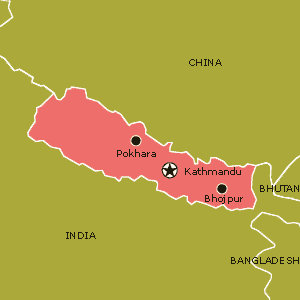

Significance
Immigration from Nepal has generally reflected educational opportunities, professional employment, economic development, political transition, family reunification, refugee resettlement, skilled migration, and international business.
Migration from Nepal has historically been shaped by its geographic location between India and China, longstanding labor migration, and expanding educational and professional opportunities. Nepalis have commonly migrated to India under the open-border arrangement, as well as to the Gulf countries, Malaysia, the United Kingdom, and other destinations for employment, education, and family connections. Migration to the United States increased significantly during the late twentieth and early twenty-first centuries through higher education, skilled employment, family sponsorship, refugee resettlement, and the Diversity Visa Program. Today, Nepali immigrants have established vibrant communities across the United States while maintaining strong cultural, linguistic, and family ties with their homeland.
Nepali Migration Before Independence
Unlike many countries in South Asia, Nepal was never formally colonized by a European power. During the nineteenth and early twentieth centuries, migration was influenced by agriculture, regional trade, military service, government administration, and religious pilgrimage. Many Nepalis travelled to India as traders, farmers, students, teachers, and members of extended families, while others served as Gurkha soldiers in the British and Indian armies. Direct migration to the United States remained relatively limited because educational, political, and commercial connections were concentrated primarily within South Asia and the United Kingdom. Nepal and the United States established diplomatic relations on April 25, 1947, strengthening educational and economic cooperation in the decades that followed.
Late-Twentieth- and Early-Twenty-First-Century Immigration
Migration increased after the restoration of democracy in 1990, the Nepalese Civil War (1996–2006), and expanding global educational and professional opportunities. Students, physicians, engineers, scientists, academics, entrepreneurs, information technology specialists, business professionals, and researchers increasingly travelled to the United States for university education, specialized employment, scientific research, investment, or family reunification. The resettlement of Bhutanese refugees of Nepali origin from camps in Nepal also contributed significantly to Nepali-speaking communities in the United States through humanitarian programs. In the United States, Nepali immigrants often rely on family networks, temples, churches, cultural associations, refugee assistance organizations, alumni groups, and professional organizations for support with housing, employment, education, language services, and community integration while preserving Nepali and other Indigenous languages, traditional cuisine, festivals, religious practices, cultural heritage, and close relationships with relatives in Nepal